Bhagavad Gita
A dialogue between Krishna and Arjuna on action, knowledge, devotion, discipline, and liberation.
Depth 2 of 4
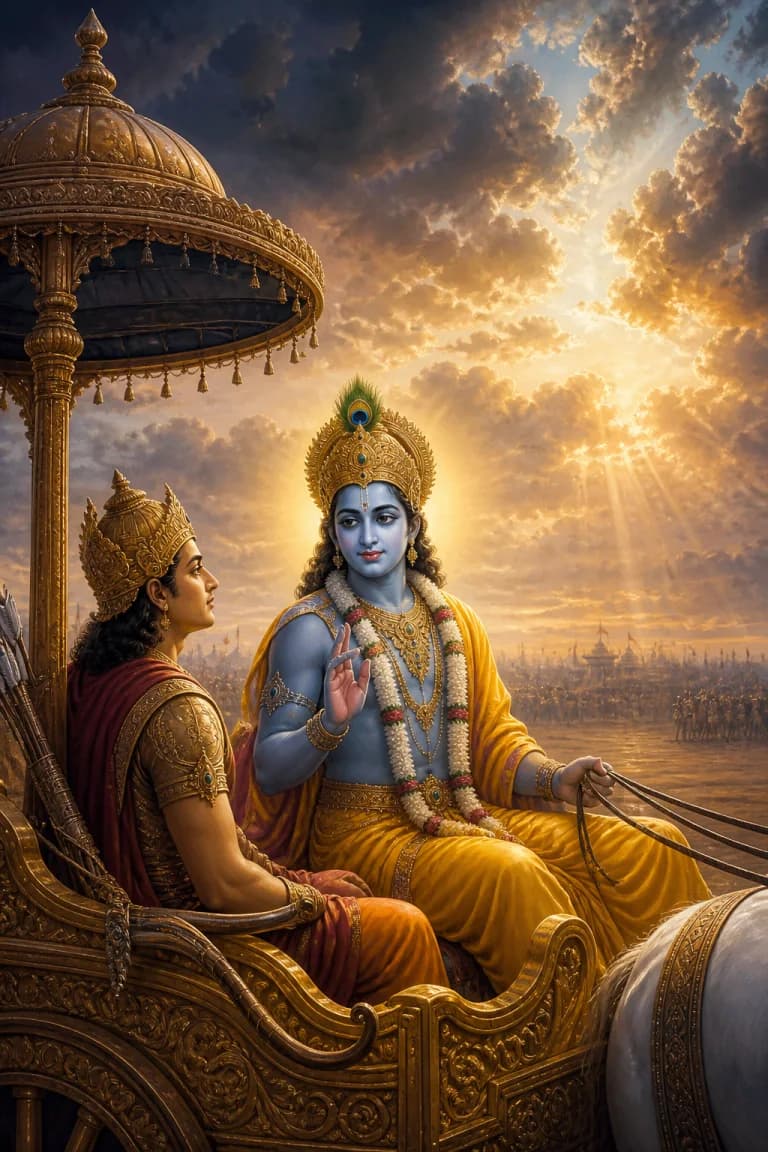
The Bhagavad Gita appears within the Bhishma Parva of the Mahabharata. Its teaching begins when Arjuna faces a crisis of duty and asks Krishna for guidance.
A teaching through dialogue
Krishna responds through a progressive conversation rather than a single doctrine. The text brings disciplined action, contemplative knowledge, meditation, and devotion into relation.
- Act with attention while releasing possessiveness over results.
- Examine the nature of self, duty, and change.
- Steady the mind through practice and discernment.
- Offer action through devotion rather than egoistic ownership.
कर्मण्येवाधिकारस्ते मा फलेषु कदाचन । मा कर्मफलहेतुर्भूर्मा ते सङ्गोऽस्त्वकर्मणि ॥
Transliterationkarmaṇy evādhikāras te mā phaleṣu kadācana | mā karmaphalahetur bhūr mā te saṅgo ’stv akarmaṇi ||
TranslationYou have a right to action alone, never to its fruits. Let not the fruits of action be your motive, nor let your attachment be to inaction.
English translation: Ralph T. H. Griffith, 1896.Frequently asked
What is Bhagavad Gita?
Bhagavad Gita is a node in the Sanatan Dharma knowledge map. This page places it within its scriptural, philosophical, or living-tradition context and links to its branches, sources, and related paths.